A tyrannosaur fossil discovered near Elephant Butte Lake in New Mexico is about 4 million years younger than a 2024 study estimated, according to new research by New Mexico State University geologists.
The researchers dated the fossil-bearing rock layers to 69.4 million years ago, challenging the earlier estimate of 73 million to 74 million years, NMSU said in a Nov. 18 announcement.
The findings were published this month in Geology, a journal of the Geological Society of America. The paper, titled "High-precision U−Pb zircon geochronology establishes a mid-Maastrichtian age for the Hall Lake tyrannosaur of southern New Mexico," challenges the age estimate used in a 2024 study published in Scientific Reports.
That earlier study, led by paleontologist Sabastian G. Dalman and colleagues, identified the fossil as Tyrannosaurus mcraeensis, a proposed older sister species to T. rex. The researchers based their classification in part on an estimated age of 73 million to 74 million years.
Jeffrey Amato, an NMSU geology professor and co-author of the new study, said his team took a more focused approach to dating the rock layers surrounding the fossil.
"We went in and did a more focused study to try to figure out the ages of the rocks below, at, and above the dinosaur fossil level," Amato said in the NMSU announcement. "We were dating zircons in sandstones, and we came up with an age for the dinosaur strata that was 69 million, not 74 million years ago."
The fossil is a jawbone recovered from the shoreline of Elephant Butte Lake at the Armendaris Ranch in 1983. Paleontologists initially identified it as T. rex because of its similar anatomy. The 2024 team proposed a different classification after estimating that the fossil was significantly older than known T. rex specimens.
Amato's team included emeritus professor Timothy Lawton and master's student Emma Schantz. The researchers studied sedimentary layers at the fossil site in the McRae Basin and used zircon geochronology, a method that determines the age of rocks by measuring the radioactive decay of uranium into lead in microscopic zircon crystals.
Amato sent samples to Jim Crowley, a research scientist at Boise State University, for high-precision testing, according to NMSU.
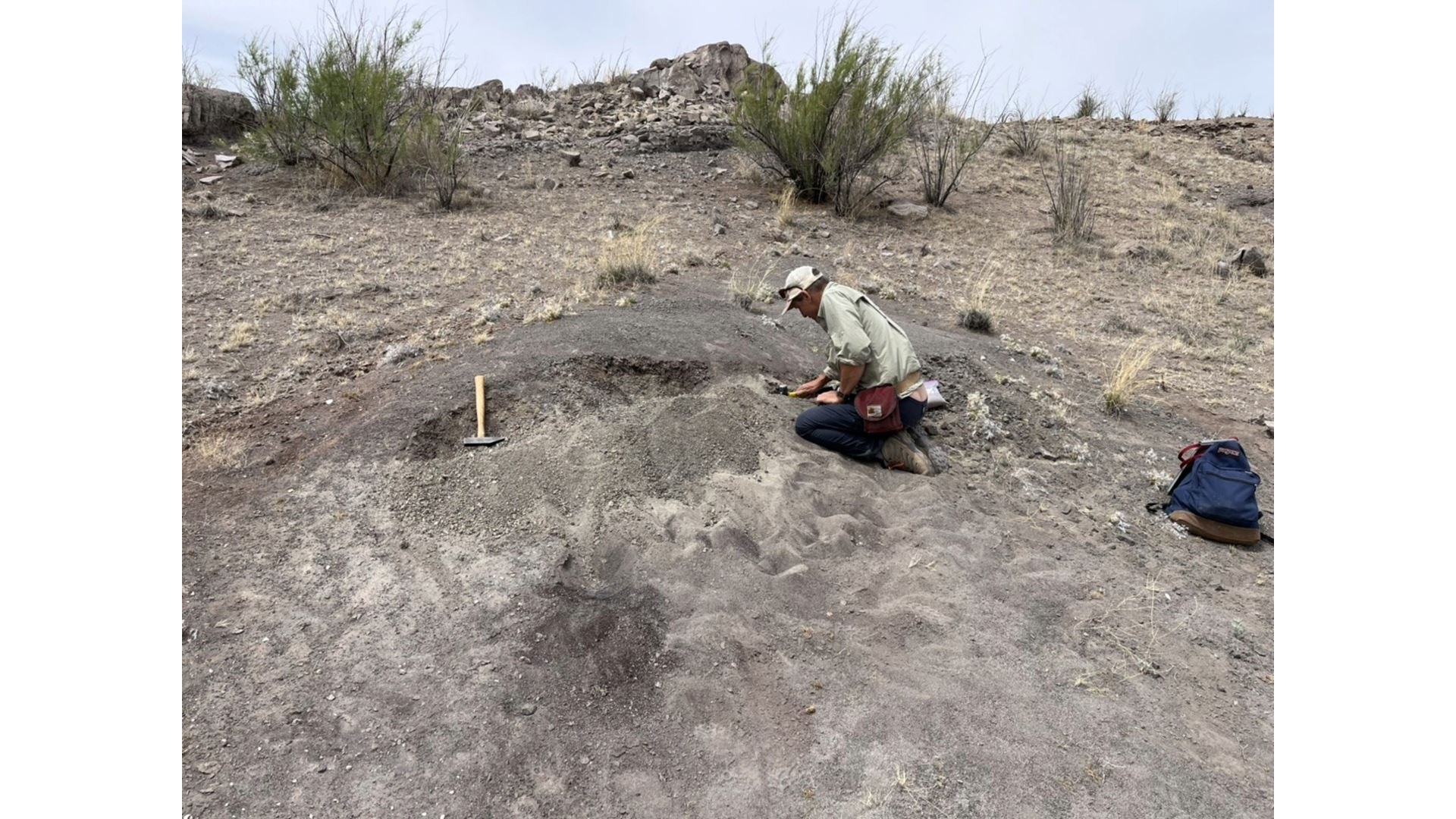
A key discovery came during fieldwork when Lawton spotted a white band of volcanic ash at the fossil quarry, beneath the siltstone layer that contained the bones.
"We were sort of scratching around on the hillside, and I said, 'Jeff, look at this white stuff. I think this is a tuff,'" Lawton said.
A tuff is a layer of consolidated volcanic ash that can contain zircon crystals used for dating. Finding one at the fossil quarry, close to the fossil-bearing layer, is extremely rare in paleontology, NMSU said.
The revised age of 69.4 million years is still older than known T. rex specimens, but it is considerably younger than the 2024 study proposed. The new research does not settle the fossil's classification.
"This species is kind of up for grabs in terms of how paleontologists are going to identify it," Lawton said. "Because suddenly, if it's a different animal that was living at the same time as T. rex, then there were two giant predators at the same time."
Amato said the fossil may now be the best-dated tyrannosaur in North America. Whether it represents the oldest known T. rex or a different species remains an open question for paleontologists, according to the NMSU researchers.