Two New Mexico State University professors have received a $600,000 federal grant through the Defense Advanced Research Projects Agency (DARPA) to research ways to make artificial intelligence more reliable, explainable and easier for people to verify, NMSU announced.
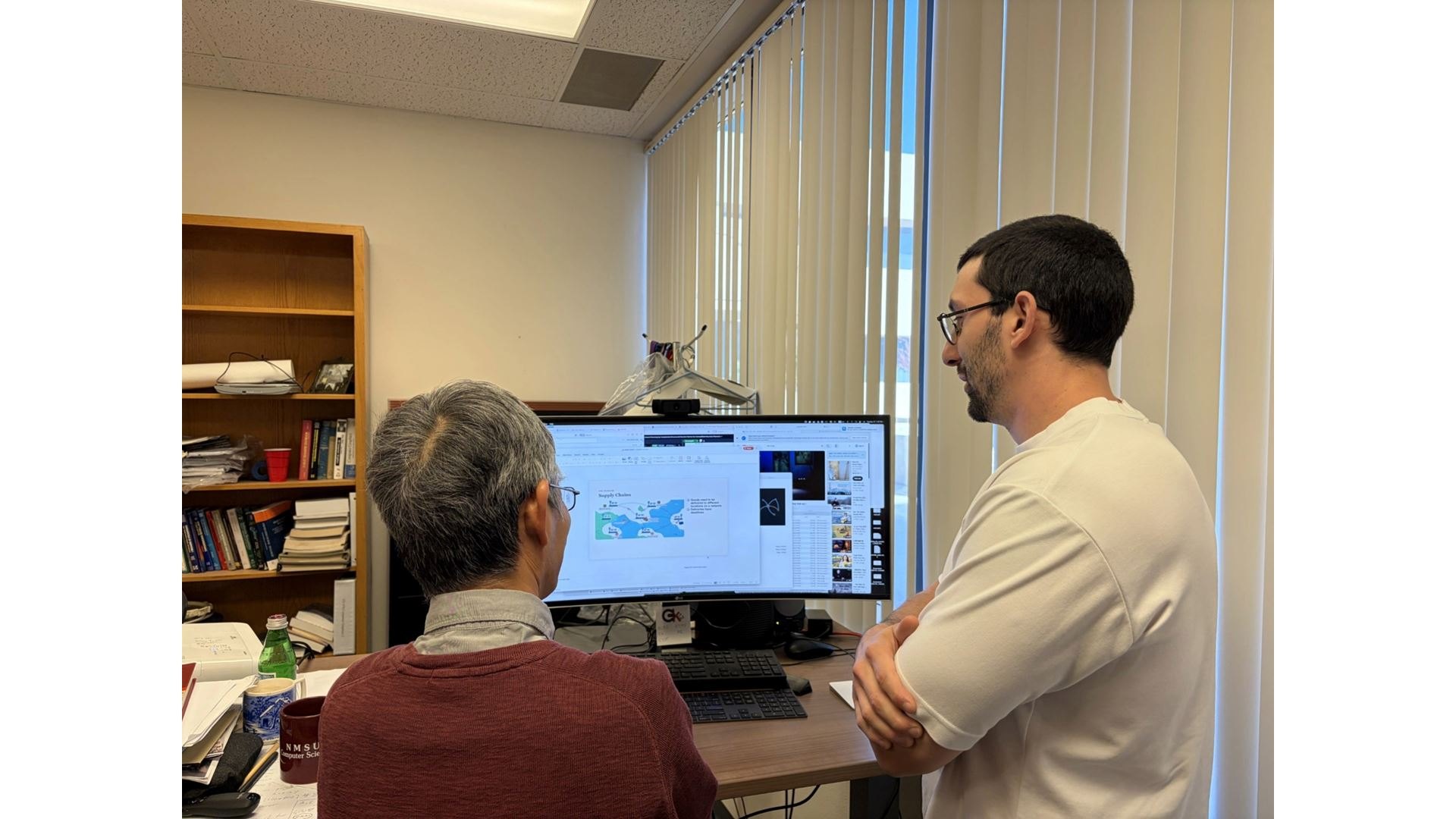
Son Tran, a computer science professor and department head, and Stylianos Vasileiou, an assistant computer science professor, are leading one of 10 teams nationwide selected for funding through the Defense Advanced Research Projects Agency, NMSU announced Nov. 20. The two-year award supports work under DARPA's CLARA program, short for Compositional Learning-And-Reasoning for Automated Complex Systems Engineering.
DARPA describes CLARA as a research program intended to combine automated reasoning with machine learning to create AI systems with stronger assurances about how they reach conclusions. The agency identifies potential applications in areas including medical guidance, finance, law, autonomous systems and defense.
The NMSU team's proposal, called SPARTA — Splitting-based Polynomially-bounded Automated Reasoning with Tensorized Adaptation — aims to combine machine learning's ability to recognize patterns with logic-based programs that can provide explanations for their conclusions.
AI systems that rely heavily on machine learning can produce answers without offering explanations people can readily verify. The NMSU researchers want to develop methods that pair those systems with formal reasoning tools.
“Right now, AI generally splits into two camps. One is great at spotting patterns quickly, and the other is great at following strict logic. Combining them gives you the best of both worlds,” Vasileiou said in NMSU's announcement of the grant. “You are getting an AI that can think fast on its feet while still showing its work in a way humans can verify and trust.”
Tran said the project will focus on combining machine learning approaches with logic programs so AI systems can explain their answers, a feature he described as a key difference from contemporary machine learning systems.
The NMSU team is collaborating with researchers at Arizona State University and the University of Nebraska at Omaha. The Arizona State group is led by Chitta Baral, a professor in the university's School of Computing and Augmented Intelligence. The Nebraska team includes Yuliya Lierler and Jorge Fandinno, computer science faculty members whose research includes artificial intelligence and automated reasoning.
The grant adds to a year of recognition for the NMSU researchers. In July, Tran received two Test of Time Awards for earlier work in artificial intelligence, while Vasileiou received an Early Career Award at the 2026 International Conference on Principles of Knowledge Representation and Reasoning in Lisbon, Portugal, according to a separate NMSU announcement.
The official KR 2026 awards listing identifies one of Tran's recognized papers as “Adapting Golog for Composition of Semantic Web Services,” co-authored with Sheila McIlraith of the University of Toronto. The award recognizes research published at least 15 years earlier that has had a lasting impact on the field.
A second Test of Time Award recognized logic programming research co-authored by Tran and NMSU College of Arts and Sciences Dean Enrico Pontelli, the university said.
Vasileiou's Early Career Award recognized his contributions to explainable decision-making. He also received the 2026 Outstanding Dissertation Award from the International Conference on Automated Planning and Scheduling. The ICAPS award record lists his dissertation, “Explainable Decision-Making: From Formal Logic to AI Systems with Explainable Behavior,” among the award recipients.